|
New fire report – Pine Grove fire (posted 7/1/2025)
Bridger-Teton National Forest
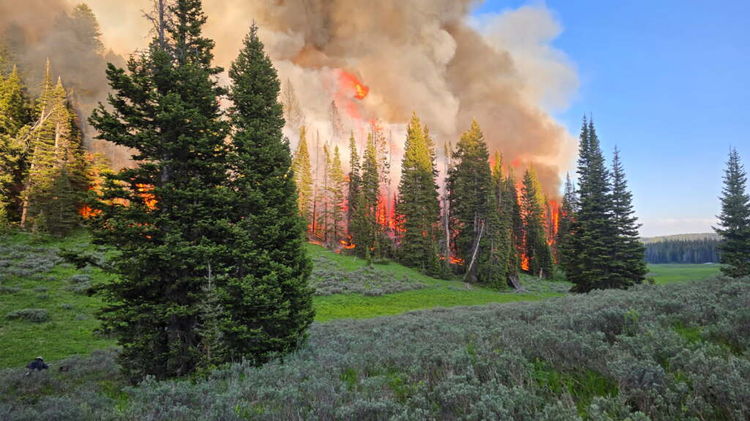
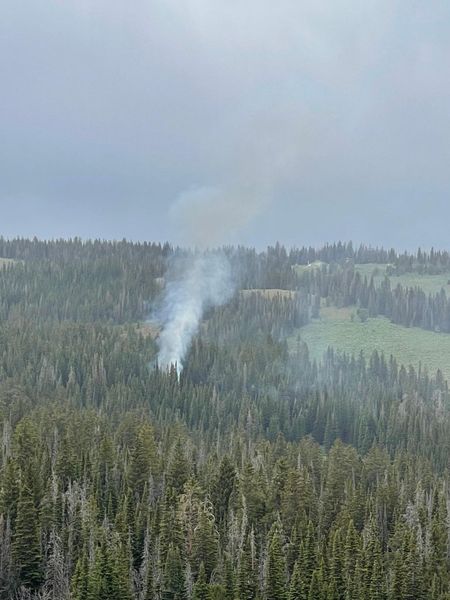
Firefighters on the Bridger-Teton National Forest are responding to the #PineGrove fire reported the evening of Tuesday, July 1, 2025 located off of Pine Grove Ridge Road, approximately 2 miles from Deadline Ridge, roughly 10 miles southwest of Big Piney, Wyoming. The fire is estimated at three acres. Firefighters will have to hike into it as there are no roads close to the smoke. There is a very high spread potential as it is burning in heavy dead and down spruce and fir trees. Two helicopters are on scene and the Forest is mobilizing a crew. This is a full-suppression fire. The cause is undetermined. There are no closures at this time. The fire is producing three separate columns of smoke. Please do not report.
(Source: Bridger-Teton National Forest Facebook page)

Maya De Vitry
|
Pinedale’s Soundcheck Summer Music Series continues July 4 with former Stray Bird Maya De Vitry (posted 7/1/2025)
Free picnic, fireworks and kids activities
Pinedale Fine Arts Council
Pinedale’s Soundcheck Summer Music Series continues Friday, July 4th with Nashville-based singer songwriter Maya De Vitry (formerly of the The Stray Birds) headlining with her band. Special guests Shelby Means & Joel Timmons, a Nashville-based Americana duo will play direct support and local acts The Booms & the Bust (duo) and Jamie Hansen (solo) will perform opening sets beginning at 3:30 p.m.
All Soundcheck shows are presented by the Pinedale Fine Arts Council (PFAC) and take place at American Legion Park in downtown Pinedale. Shows are free to the public and are kid/pet friendly and feature food/drink vendors and activities for kids.
The July 4th Soundcheck will also coincide with the Town of Pinedale’s annual 4th of July Picnic (noon-2pm, Free). So come early for free hot dogs and hamburgers (BYO sides and beverages) and then stay late for a night of music before checking out Pinedale’s famous fireworks show at sundown.
Maya de Vitry is a Nashville-based singer-songwriter, recording artist, producer, and multi- instrumentalist whose music blurs the lines of folk, country, indie rock, and Americana. An admirer of the dedicated song craft of writers like John Prine, Gillian Welch, and Townes Van Zandt — and of the stirring vocals of artists like Bonnie Raitt and Nina Simone — Maya de Vitry’s music invites listeners into a space of openness and connection.
After a formative chapter of touring and recording as a member of roots-Americana trio The Stray Birds, Maya launched a solo career with her 2019 album Adaptations, earning praise from Rolling Stone Country, NPR Music, and No Depression. Since then, she has independently released four records and has nurtured a devoted community of listeners. With a magnetic voice and a hard-won sense of purpose, she has toured across North America and Europe, supporting artists like The Wood Brothers, Aoife O’Donovan, John Craigie, and Mighty Poplar.
When she is not traveling, Maya thrives in more behind-the-scenes roles, working in recording studios as a producer for other artists within her musical circle (Joel Timmons, Shelby Means, Hannah Delynn). Her songwriting appears on albums by Molly Tuttle, Lindsay Lou, Bronwyn Keith-Hynes, and Steve Poltz, and her skills as a multi-instrumentalist and harmony singer have contributed to many Nashville recordings.
All Soundcheck shows are free and feature food/drink vendors and a fun, family-friendly atmosphere.
For full the Soundcheck lineup and more information please
visit www.soundcheckpinedale.com and be sure to plan your trip to Pinedale at www.visitpinedale.org.
Soundcheck sponsors include Pinedale Travel & Tourism / Sublette County Recreation Board / The Pinedale Lodging Tax / High Mountain Real Estate / First Bank of Wyoming / Stantec / Four Pines Physical Therapy / Bank of Jackson Hole / Two Rivers CPA / Memorial Hospital of Sweetwater County / Jorgensen Associates / HUB International / Katie Robertson, Associate Broker at Keller Williams Jackson Hole / Wyoming Public Radio & Media / Wyoming Community Foundation / Blue Spruce Operating.

|
Sublette County Hospital receives Provisional License (posted 7/1/2025)
Sublette County Hospital District
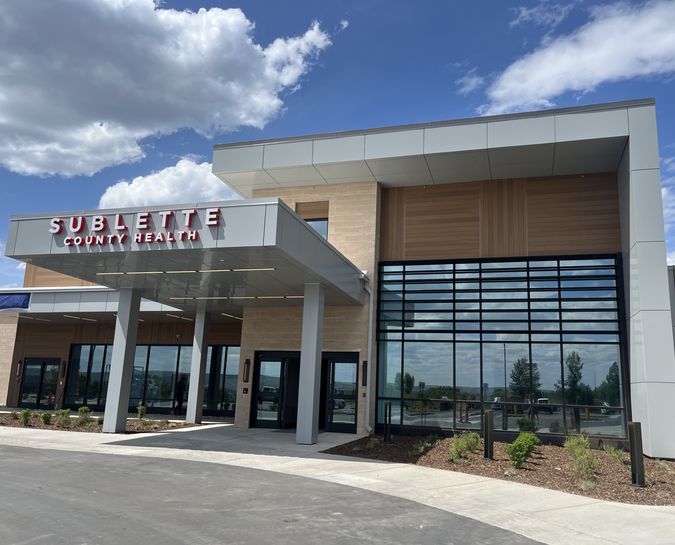
Sublette County Hospital has reached a major milestone in the journey to opening its doors, officially receiving its provisional hospital license from the State of Wyoming on June 23, 2025.
This achievement follows the hospital’s successful life safety and construction inspection, which verified that the new facility meets all necessary standards to safely care for patients. Passing this inspection—one of the most critical steps in the licensing process—demonstrates that every space, system, and safety measure in the hospital has been thoughtfully designed and built to deliver high-quality care.
"This milestone is the result of extensive teamwork, attention to detail, and months of preparation," said Gregory Brickner, Interim CEO. "Our staff worked proactively to prepare our hospital license application, which allowed us to submit it immediately after our life safety inspection and stay right on track."
With the provisional license secured, the hospital is now focused on the final regulatory step before opening: obtaining its license from the U.S. Drug Enforcement Administration (DEA). Once approved, this will enable the facility to begin stocking the pharmacy that will serve the hospital patients and Heritage Home residents.
The Heritage Home residents are scheduled to move from the current Sublette Center into their new home on August 26th.
The hospital is preparing for its future designation as a Critical Access Hospital (CAH), a federal program that supports rural hospitals in maintaining essential services. "By preparing early and staying organized, we’re ensuring smooth transitions every step of the way," said Brickner.
These accomplishments mark exciting progress for Sublette County Health and bring the new hospital one step closer to serving the people of Sublette County with expanded care and services.
Bridger-Teton National Forest releases Draft Assessment (posted 7/1/2025)
Seeks public review and comment
Bridger-Teton National Forest
The Bridger-Teton National Forest invites the public to review and comment on its draft assessment and potential species of conservation concern, available beginning July 11 at fs.usda.gov/r04/bridger-teton/planning. The draft assessment is the first step in the multi-year process to update the Bridger-Teton Forest Plan.
The draft assessment is a summary of the "State of the Forest" and presents information about current ecological, social and economic conditions, and trends affecting the Bridger-Teton. Once finalized, the assessment informs updates to the Bridger-Teton Forest Plan.
The forest plan functions like a county comprehensive plan or zoning document. It provides comprehensive, strategic, and integrated resource direction that guide all decisions about future projects and uses on the Bridger-Teton National Forest. Planning ensures a sustainable future with balanced and thoughtful use and protection of the many resources on our public lands.
Upcoming Public Meetings
In-person engagement opportunities are planned so you can speak with us about the draft assessment. To kick off this effort, we invite you to attend one of three upcoming open houses in Afton, Jackson, or Pinedale. The open houses are planned for:
July 14 at the Afton Civic Center Room 125 A&B, 150 Washington Street, in Afton, Wyo., from 5 to 7 p.m.
July 15 at the Teton County Library Ordway Auditorium, 125 Virginian Lane, in Jackson, Wyo., from 5 to 7 p.m.
July 17 at the Pinedale Library Lovatt Room, 155 South Tyler Avenue, in Pinedale, Wyo., from 5 to 7 p.m.
In addition to these open houses, the Bridger-Teton Forest Plan Engagement Team is working with community members to set up discussions in communities surrounding the Forest. Dates and times for these locations will be posted on the Forest planning webpage. Come chat with us!
"We look forward to sharing information on the status and trends in a wide range of topics, including fire management, recreation, wildlife migration corridors, forest products, terrestrial and aquatic ecological integrity, range management, potential species of conservation concern and more," said Bridger-Teton Forest Supervisor Chad Hudson. "We will also discuss the forest planning process and how to provide comments."
How to Provide Public Comment
The Forest invites you to submit comments on the draft assessment at https://cara.fs2c.usda.gov/Public/CommentInput?project=63628 beginning July 11 and continuing through Aug. 24, 2025.
"The central question is: do you think the draft assessment provides sufficient information to help identify where the Forest should focus on updating management direction?" said Hudson.
Effective comments are specific, relevant to the document, and include facts, data, or local knowledge that can help improve the information needed for the next steps in the forest planning process. Comments submitted through social media, phone calls, email, or mail will not be accepted.
After the comment period ends, the Forest will review all comments and use the information provided to make any necessary updates to produce the final assessment.
Learn more
Help shape the future of the Bridger-Teton National Forest so together we can care for the land and serve people for generations to come. Visit the Bridger-Teton National Forest planning webpage (https://www.fs.usda.gov/r04/bridger-teton/planning) to learn more.
Horse Fire update - June 29, 2025 (posted 6/29/2025)
Bridger-Teton National Forest
Status: Active. Spotting. Torching.
Size: 2,677.4 acres; 59 percent containment
Objectives for the Fire: Full suppression of the fire.
Resources: 1 - Type 1 Helicopter, 1 - Type 2 Helicopter, 1 - Type 3 Helicopter, 1 - Type 1 Hot Shot Crews, 3 - Type 2 IA Crews, 2 - Aerial Apparatus (UAS), 1 - Type 3 Engine, 1 – Type 6 Engine, 2 - Water Tenders
Personnel: 152
Today’s Strategy: Sunday, June 29, 2025, at 6:00 AM another Wyoming Type 3 Team assumed command of the Horse Fire. Today, crews will continue to hold and improve containment lines. Along the northeast corner of the fire, crews will conduct firing operations if needed to target unburned fuel pockets within the interior. In the area surrounding the 2007 Horse Creek fire burn scar, efforts will continue with mop up operations, identifying lingering hot spots and reinforcing the fires perimeter.
Forecast Over the Horse Fire: Sunday will be another warm day; with afternoon humidity values a little drier than on Saturday. Afternoon winds remain breezy though slightly lower than Saturday with gusts to around 20 mph before decreasing after sunset. The warm and dry trend will persist through early next week, with precipitation chances of not returning until midweek. Overnight humidity recovery will remain poor through this period.
More information: href="https://inciweb.wildfire.gov/wybtf-horse-fire">https://inciweb.wildfire.gov/wybtf-horse-fire
Applications being accepted to fill opening for Sublette County Clerk (posted 6/27/2025)
Deadline to apply is July 7, 2025
Sublette County Republican Party
With the resignation of the current Sublette County Clerk, Carrie L. Long, the Sublette County Board of County Commissioners has declared a vacancy in the Office of the County Clerk, effective June 24, 2025. Since this office was occupied by a Republican candidate, the Sublette County Republican Party Central Committee is required to forward the names of three (3) candidates to the Sublette County Board of County Commissioners for its consideration to fill the vacancy.
Qualifications: Must be bondable, and a resident of Sublette County.
To apply: Submit a Letter of Intent, a resume including complete work history, and three (3) letters of reference, with the letters limited to 1 page each, to scrp23wy@gmail.com by noon July 7, 2025. Applications may be submitted by hand by contacting Mary Lankford, SCRP Secretary at 307-367-4820. All candidates must be available to meet with the Sublette County Republican Party Central Committee on July 8, 2025, at 5 p.m., in the School Board Meeting Room of the Administration Building located at 665 North Tyler, Pinedale, Wyoming. This meeting will be open to the public.
/s/Albert Sommers, Chairman
Sublette County Republican Party
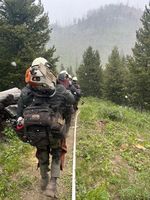
Snowing. Horse Fire June 24, 2025.
|
Horse Fire update – June 25, 2025 (posted 6/26/2025)
Bridger-Teton National Forest
Status: Active. Spotting. Torching.
Size: 2,320 acres; 20 percent containment
Objectives for the Fire: Full suppression of the fire.
Resources: 3 - Type 1 Hot Shot Crews, 3 - Type 2 IA Crews, 1 - Type 3 Engine, 1 – Type 6 Engine, 1 - Type 1 Helicopter, 1 - Type 2 Helicopter, 1 - Type 3 Helicopter, 1 – Dozer, 1 - Water Tender, 2 - Aerial Apparatus (UAS)
Personnel: 203
Today’s Strategy: Rain showers over parts of the fire yesterday prevented planned firing operations. With favorable weather conditions today, firing operations will resume to improve control lines and secure the north, northeast areas of the fire. Today the focus will be aggressive mop up work and tactics to keep the fire out of the drainage area in the South Horse Creek area. Heavy down timber has created challenges in the northeast corner of the fire as crews work to secure perimeter.
Forecast: Winds today will start off light and variable, much like previous days, becoming west southwesterly around 12;00. Gusts to 15 to 20 mph will continue from the west-southwest through around 7:00 pm to 8:00 pm this evening. Winds return to light downslope/downvalley flow overnight. The same pattern will persist for the next several days, into the weekend. Winds look to be strongest Friday afternoon with gusts 20 to 25 mph possible. Precipitation opportunities remain generally minimal, with the best chances of the week being this afternoon (10% chance). Afternoon minimum RHs are generally expected to be in the 20 to 25% range and temperatures will be slightly warmer today. The slight warming and drying trend look to continue through the end of the week, with Friday being the warmest and driest day of the week.
Fire Danger: Teton Interagency Fire managers have elevated the fire danger rating to "HIGH" for Grand Teton National Park, Bridger-Teton National Forest, and the National Elk Refuge.
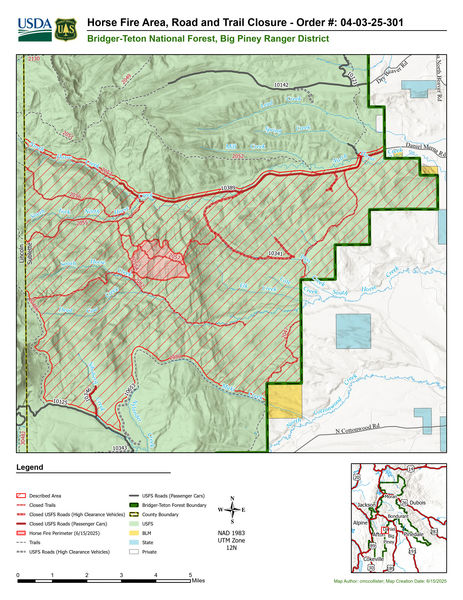
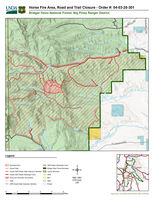
Closures: A Horse Fire Area Road and Trail Closure is enacted from 7 a.m. on 6/16 through July 31 at 6 a.m. for public and firefighter health and safety during the Horse Fire, unless rescinded. Starting at Forest Road 10389 (Horse Creek Road), south along the Forest Boundary to Trial 2080 (Maki Creek) to Forest Road 10653 (Nylander Road), and northwest along Forest Road 10125 to Lincoln County Sublette County line to trail 2053 (North Horse Creek Trail) and east to Horse Creek Road. Forest Service Trial 2080 (Maki Creek Trail) and FS Roads 10653 and 10125 are open.
Restrictions: A Temporary Flight Restriction (TFR) is in place over the fire. Drones are prohibited from being flown anywhere near the fire area.
To check air quality in the area, visit: https://fire.airnow.gov
Visit https://inciweb.wildfire.gov/wybtf-horse-fire for more information and related links.
Horse Fire update – Thursday, June 19, 2025 (posted 6/19/25)
Horse Fire update – Thursday, June 19, 2025
Status: Active. Spotting. Torching.
Size: 1,456 acres; 6 percent containment
Objectives for the Fire: Full suppression of the fire.
Resources: 4 - Type 1 Hot Shot Crews, 3 - Type 2 IA Crews, 2 – Wildfire Use Modules, 2 Type 3 Engines, 1 - Type 1 Helicopter, 1 - Type 2 Helicopter, 1 - Type 3 Helicopter, 1 - UAS, 1 Water Tender
Personnel: 236
Today’s Strategy: With warmer and drier conditions coming back into the fire area Thursday, resources on the southern end of the fire will be focused on holding areas from the previous two shifts as well as continuing to fire pockets of unburned that could potentially threaten the lines. As wind continues to shift, the Northern part of the fire will evaluate the opportunities to fire off indirect lines.
Forecast: Expect sunny skies with a high of 81°F and a low of 49°F. Winds will be coming from the southwest at around 12 mph, and the chance of precipitation is very low at just 3%. Relative humidity will dip as low as 14%, which could contribute to dry conditions.
Fire Danger: Teton Interagency Fire managers have elevated the fire danger rating to "MODERATE" for Grand Teton National Park, Bridger-Teton National Forest, and the National Elk Refuge. The potential for fire activity has increased due to drying of vegetation combined with warmer and windier conditions.
Closures: A Horse Fire Area Road and Trail Closure is enacted from 7 a.m. on 6/16 through July 31 at 6 a.m. for public and firefighter health and safety during the Horse Fire, unless rescinded. Starting at Forest Road 10389 (Horse Creek Road), south along the Forest Boundary to Trial 2080 (Maki Creek) to Forest Road 10653 (Nylander Road), and northwest along Forest Road 10125 to Lincoln County Sublette County line to trail 2053 (North Horse Creek Trail) and east to Horse Creek Road. Forest Service Trial 2080 (Maki Creek Trail) and FS Roads 10653 and 10125 are open.
The described roads and trails include the following national forest system roads and trails located within and bordering the described area:
1. Forest Road 10341, 10346, 10389 (Horse Creek Road).
2. Portions of national forest system (NFS) trail numbers: 2053 (North Horse Creek), 2056 (Corlos Creek), 2047 (Old Indian),
3. NFS Trail Nos. 2082 (South Horse Creek), 2057 (Prospect Mountain)
Restrictions: Drones are prohibited from being flown anywhere near the fire area. Drones flying on the fire 6/14/25, halted aerial firefighting efforts for safety. When unauthorized drones enter wildfire airspace, firefighting aircraft are often grounded to prevent midair collisions. If you fly. We can’t. Drones are illegal in wildfire airspace.
Caution: Even during moderate fire activity, conditions can change rapidly. Flare-ups may occur due to shifts in wind patterns or an increase in dry fuels, leading to unexpected road hazards or intensified smoke. Fire activity may result in air quality changes. To check air quality in the area, visit: https://fire.airnow.gov
More Information:
Visit https://inciweb.wildfire.gov/wybtf-horse-fire for more information and related links.
Information: (307) 413-2481
|
Horse Fire update – Monday, June 16, 2025 (posted 6/16/2025)
898 acres
Bridger-Teton National Forest
• Active: Exhibiting spotting and torching behavior.
• Size: 898 acres.
• Containment: 6 percent.
• Objectives: Full suppression.
• Resources Deployed: 3 engines, 1 Type 1 helicopter, 1 Type 3 helicopter, 2 Type 1 Hot Shot crews.
• Personnel: 82
*The updated acreage of the Horse Fire reflects the latest precise imaging of the fires perimeter.
CLOSURE ORDER: A Horse Fire Area Road and Trail Closure is enacted from 7 a.m. on 6/16 through July 31 at 6 a.m. for public and firefighter health and safety during the Horse Fire, unless rescinded. Starting at Forest Road 10389 (Horse Creek Road), south along the Forest Boundary to Trial 2080 (Maki Creek) to Forest Road 10653 (Nylander Road), and northwest along Forest Road 10125 to Lincoln County Sublette County line to trail 2053 (North Horse Creek Trail) and east to Horse Creek Road. Forest Service Trial 2080 (Maki Creek Trail) and FS Roads 10653 and 10125 are open.
The described roads and trails include the following national forest system roads and trails located within and bordering the described area:
1. Forest Road 10341, 10346, 10389 (Horse Creek Road).
2. Portions of national forest system (NFS) trail numbers:
2053 (North Horse Creek), 2056 (Corlos Creek), 2047 (Old Indian),
3. NFS Trail Nos. 2082 (South Horse Creek), 2057 (Prospect Mountain)
Restrictions: Drones are prohibited to be flown anywhere near the fire area. Drones flying in the area of the fire on 6/14/25, halted aerial firefighting efforts for safety. When unauthorized drones enter wildfire airspace, firefighting aircraft are often grounded to prevent midair collisions. If you fly. We can’t. Drones are illegal in wildfire airspace.

|
WYDOT warns about texting scams (posted 6/9/2025)
Don’t click on links in suspicious text messages
Wyoming Department of Transportation (WYDOT)
CHEYENNE, WYOMING – The Wyoming Department of Transportation (WYDOT) wants to warn the public about ongoing text-based scams targeting Wyoming residents.At least two recent scams have posed as WYDOT to try to trick residents into clicking/tapping a link to a spoofed version of the WYDOT website. The scammers use varying language, but ultimately threaten an immediate loss of driver privileges if action isn’t taken on unpaid citations or toll bills.
WYDOT does not contact customers this way.
Here are some red flags to watch for if you receive a suspicious text:
• If it’s from a foreign phone number, it’s a scam. WYDOT does not use foreign call/text services of any kind.
• If it says "The DMV" it’s a scam. WYDOT does not call itself a DMV; all communication from WYDOT about a driver license is from Driver Services.
• WYDOT does not offer any option to pay citations online. All citations are handled through the court system, independent of WYDOT.
• Wyoming has no toll roads. WYDOT will not contact you about unpaid tolls in other jurisdictions.
• Generally, WYDOT will not contact you unsolicited. Any unexpected call or text claiming to be from WYDOT should be scrutinized. Driver license renewals, specialty plate renewals, and other WYDOT business is most often conducted via mail (or via email, if first prompted by the customer).
When in doubt, call WYDOT to double check the message you’ve received is legitimate.
If you have clicked any links in a scam text, WYDOT recommends using a different device to change all passwords and reaching out to your bank through a trusted phone number.
Stay vigilant for recovery scams, where scammers try to lure victims with promises to recover all stolen funds from previous scams.
For helpful tips on how to avoid scammers, visit the Wyoming Attorney General Consumer Protection Unit’s website: https://attorneygeneral.wyo.gov/law-office-division/consumer-protection-and-antitrust-unit/consumer-education
|
Business
Directory
|